Showing posts with label fashion illustration. Show all posts

Saturday, January 21, 2012

La Femme Chez Elle

Amongst the vintage fashion magazine ads that I brought back from Paris, I found some lovely illustrations by four well-known Art Deco illustrators of the 1930s.  

Perhaps the most iconic of these illustrators was Paul Iribe,
who was part of a Parisian, bohemian clique, a cosmopolitan mix of personalities from the world of the arts and elite society.  One notable member was the couturier, Coco Chanel.  Iribe’s involvement with Chanel was particularly intense. Chanel found Iribe’s provocative wit and professional drive matched her own. Theirs was a romantic liaison, and a bond of like souls. 


   Etsy Listing #90914676

The reverse side of this listing is an illustration by Andre Edouard Marty.  He was the quintessential Parisian artist: he was born in that city in 1882, died there in 1974, and through his long and productive 92 years he touched upon virtually every major art form with the exception of sculpture.   He was only one of four artists to contribute to every year of the elite pochoir fashion publication Gazette du Bon Ton (1912 to 1925).  In addition he was much sought after as an illustrator for Vogue, Harper’s Bazaar, Le Sourire, Fémina, Modes et Manières d’Aujord’hui and many other popular fashion and lifestyle publications.

   Etsy Listing #90914676

George Lapape was also the quintessential Parisian artist.  At age 20 Lepape had already formed strong liaisons with such notable artists as Georges Braque, Marie Laurencin, Bernard Boutet de Monval, Andre Marty and Charles Martin.  By 1920 Lepape was at the very top of his profession. He had completed a prolific decade of work, including illustrations for the houses of Worth, Lanvin, Paquin, Doucet, Beer among others, cover work for Harpers Bazaar and the first cover for Vogue Magazine (Oct.1916, English edition), numerous commissions for fur, perfume and other luxury goods producers, illustrations for theatre programs (particularly for the Ballets Russes), costume and set designs for Marcel L’Herbier and a series of posters for Galeries Lafayette.

Conde Nast invited Lepape to New York in 1926, further cementing a long and profitable relationship with Vogue as that publication took over Gazette du Bon Ton. He illustrated eight of the Vogue covers in 1927 plus covers for Vanity Fair, while continuing to expand his client list to include Hermes, Wanamaker’s Department Store and Femina Magazine, among others, and to further increase his visibility in the theatrical world.

 Etsy Listing #90914611

The reverse side of the page is an illustration by Mariette Lydis.  Mariette, Comtesse Govone, lived an extraordinary life of adventure.  She had a great artistic success in 30s Paris, starting with a solo show at the Galerie Bernheim Jeune, after which she became a member and a juror at the Salon d’Automne. Her work is in many major museums and collections worldwide.

 Etsy Listing #90914611

Enjoy!
Patty

Monday, January 9, 2012

Madeleine de Rauch by Darani

I was lucky enough to find a copy of the French magazine, L'Officiel de la Couture et de la Mode de Paris, from 1949, which contains the very collectible ad illustrated by Darani.  The ad features a bright yellow wool coat and black and white wool windowpane checked trousers designed by Madeleine de Rauch, a Paris couturier, working from 1932 to 1973, who was known for her sporty day looks.

The ad is very collectible as it has been featured on page 161 of the exceptional reference book of fashion illustrators entitled, "100 Years of Fashion Illustration", which is an invaluable addition to any reference library.


 Paper Doll Girls Etsy Listing #90044120

The ad has a very modern look even though it is was done 63 years ago!  At this time, trousers were just becoming part of couture for weekend wear.  Hard to believe, isn't it, since women were them on a daily basis now?

Patty

Friday, April 22, 2011

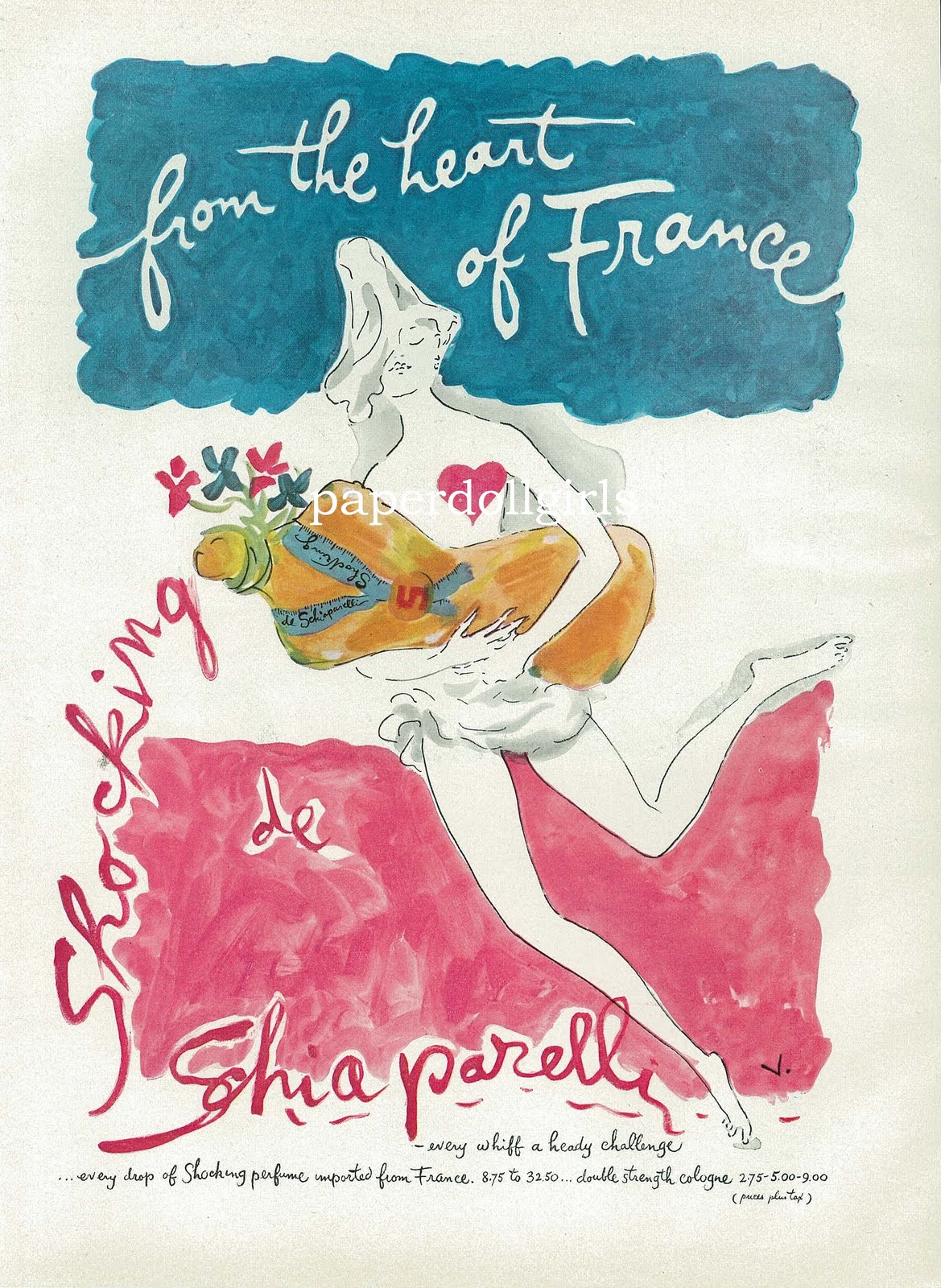
Elsa Schiaparelli and Marcel Vertes--a perfect combination

One of my favorite illustrators is Marcel Vertes, and I especially love his work for Schiaparelli perfumes.  Here are three of his ads that you will find in our shop:

  Harpers Bazaar
September 1945
Etsy Listing #70216138

Harpers Bazaar 
April 1945
Etsy Listing #70216224

 Vogue
April 1952
Etsy Listing # 71019728

Hungarian illustrator,  Marcel Vertes was born in Ujpest, near Budapest, Hungary.  He studied to become an aviation engineer, but instead turned to drawing and painting.  In the early 1920s, Vertes went to Paris, where he worked for the satirical magazine Rire, and for the Gazette Du Bon Ton.

Vertes was an outstanding painter, printmaker, illustrator and fashion designer.  His work was characterized by its economical use of line and color.  He moved to Paris during World War I, and established himself as one of the most important artistic figures of the 1920s; following the footsteps of Toulouse-Lautrec, Boutet, and Forain.  His work consisted mainly of portrayals and scenes of Paris street life, women, the circus, and cabaret acts.  Vertes went to school at the Academie Julian in Paris.
 
He became popular in France since the mid 1920s particularly for his lithographs, and illustrations.

Due to the impending World War II, Verte traveled to America where he lived and worked for some time.  His reputation as a great artist got him work as a book illustrator and costume and set designer for films, theater and musicals.  He worked briefly for Vanity Fair and Harper's Bazaar in New York before traveling to London to illustrate for Schiaparelli perfumes.  The collaboration between Vertes and Schiaparelli was an inspired one.  Verte's whimsical, and modern illustrations perfectly complimented Elsa Schiaparelli's avant-garde style and irreverent attitude.


Saturday, April 16, 2011

John Cavanagh 1956 Paper Taffeta Evening Dress Illustrated by Rene Bouche

John Cavanagh Paper Taffeta Evening Dress
UK Vogue
November 1956
Etsy #71291823

Very little detail is known about Rene Bouche himself.  Born in Europe in 1906, he arrived at what would be his "bread and butter" career at age 33, when he persuaded the editors of the French-edition of Vogue to allow him to contribute sketches of the latest fashions.  His work appeared in both the French and British versions of the magazine, and he produced one of the prettiest covers of the year, showing a milliner's shop full of the summer's bows and flowers, ribbons and laces, straws and tulles. 

It was that spring of 1941 that Bouche's career effectively began.  Almost immediately he made a considerable "second impression" on Vogue's New York editors, and he quickly became a regular contributor to the magazine.  His work was almost exclusively black-and-white sketches, with a few full-color pieces offered up when the assignment or subject-matter warranted. Stylistically, his sketches often resembled what one critic called "frantic calligraphy," yet their mood was always soft and gentle.

Friday, April 15, 2011

Schiaparelli Bengale Chiffon Evening Dress Illustrated by Reynaldo Luza

Schiaparelli Bengale Chiffon Evening Dress
Illustrated by Reynaldo Luza
Harpers Bazaar
June 1935
Etsy Listing #66900928

Elsa Schiaparelli, the flamboyant fashion designer of the Art Deco period, is renowned for her fabulous eccentricity and innovation. She changed fashion and people's attitudes to it with her scandalous dresses and colourful personality. Her legacy of spectacular designs and an entirely innovative approach to fashion design has moulded contemporary fashion and inspired countless fashion designers, including Galliano, McQueen, Gaultier and Yves Saint Laurent. In short, Elsa Schiaparelli was the woman who shaped fashion as we know it today - creating the pattern for all dresses to come.

Reynaldo Luza (1893-1978), pre-eminent fashion artist, was born in Lima, Peru. He began training as an architect at the University of Louvain, Belgium, but returned to Peru at the outbreak of World War I, where he changed his studies from architecture to art. In 1918 he came to the United States, where he earned his living by contributing drawings to several fashion publications, principally VOGUE, HARPERS BAZAAR, and VANITY FAIR. In 1921 he joined HARPERS BAZAAR as the principal fashion artist, a position he was to hold for 27 years. He divided his time between New York, Paris and London, working closely with all of the leading fashion designers of the times--Poiret, Patou, Lelong, Paquin, Douillet, Doucet, Cheruit, Worth, Drecoll, Callot Soeurs, Redfern, Martial et Amand, Premet, Reboux, Chanel, Vionnet, Molyneaux, Schiaparelli, Hartnell, Steibel, and Balenciaga, among others. In 1940 Luza made New York his principal base, where, over the next few years, he continued his activities at Harpers as well as creating fabric and furniture designs, and the costumes for the movie "The Bridge of San Luis Rey".


Related Posts Plugin for WordPress, Blogger...